
AI VisibilityArticle
ABC: the path to profitable AI visibility
Visibility is not the goal. It is an intermediary. The path from an AI model knowing you exist to money in the bank runs through three problems that share a name: the model's memory, retrieval at search time, and the handover from citation to customer. They demand entirely different work, and most people only work on one of them.
Published approx. 18 min read
In this article+–
Curious how AI talks about your brand?Run a free visibility check
"We need to become visible in ChatGPT." The sentence recurs in almost every meeting about AI search now, and the premise is right. What rarely holds up is the shopping list that follows: schema, a few FAQ blocks, and an llms.txt file. It isn't the wrong work. It's hygiene on one of three links — and the one link that bears the least weight on its own.
Because "visibility in AI" is not one problem. It's three problems that share a name, each with its own mechanism, its own clock, and its own price tag. Buy measures for one link and wait for results from another, and it looks as though AI search can't be influenced. It can. But you have to know which link you're standing in.
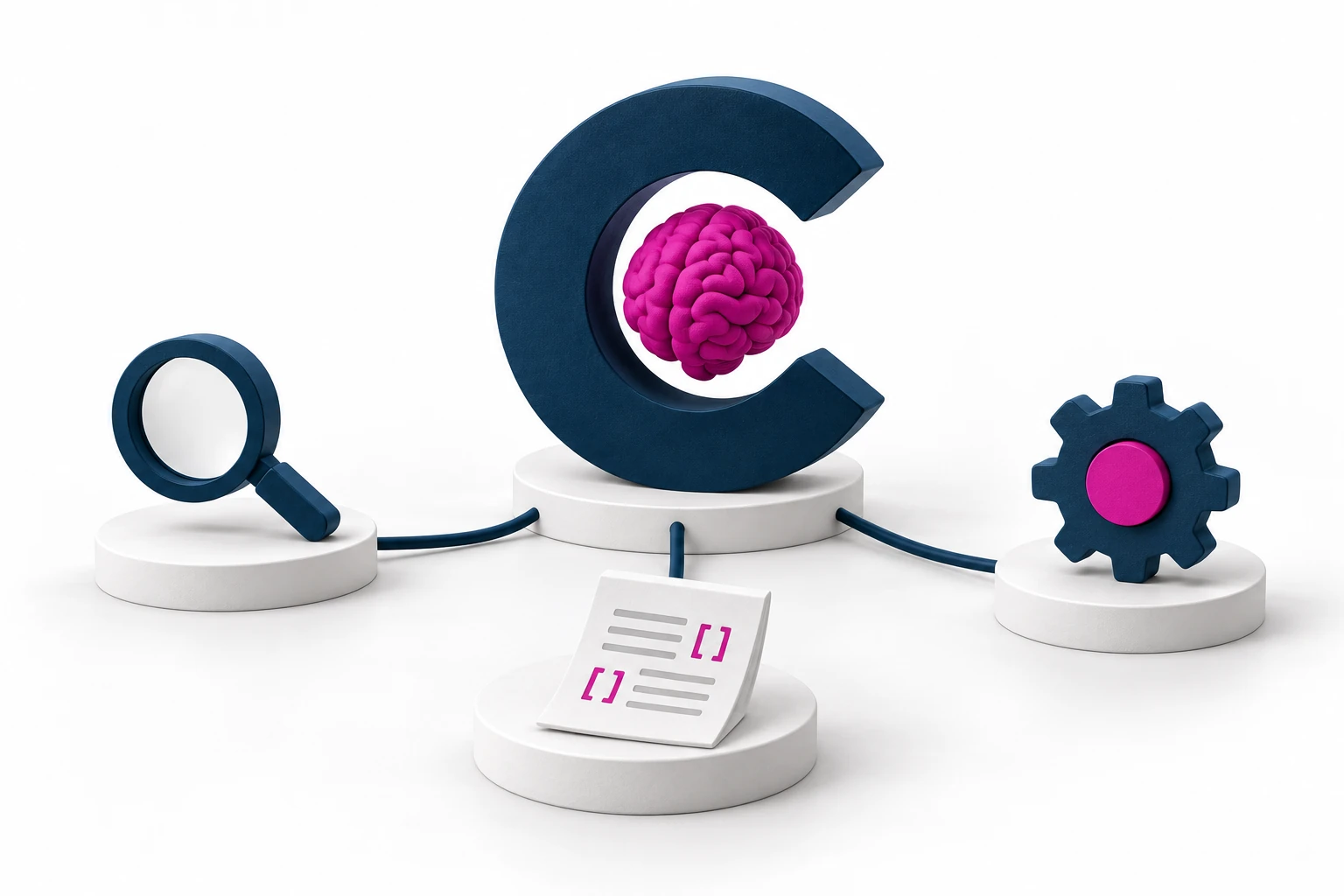
This is the ABC framework: the three links between an AI model and a paying customer.
And notice what C is. Your landing page doesn't affect whether ChatGPT mentions you. It affects whether the mention is worth anything. C, then, is not a visibility link, and that is precisely why it comes first. Visibility is not the goal, it's an intermediary — and an intermediary that never turns into value is a cost you have chosen voluntarily.
It's also why visibility scores alone are weak grounds for a decision. They measure B, occasionally a little A, and never whether any of it turned into revenue. Taken together, this is what I call AI visibility optimization — the AEO work and the handover work as one discipline, not two.
One clarification, since we're on the subject of congruence: this ABC is not the same as ABC — Acquisition, Behavior, Conversion — the commercial layer in the Citation Method that we measure the whole customer journey with. They connect, but at different levels: layers A and B here live inside Acquisition, and layer C is where Behavior and Conversion are decided.
- A
The model's memory
Does the model know who you are, without looking it up?
Parametric knowledge · model refresh: months · entity building: quarters
- B
Retrieval at search time
Are you found and cited when the model searches the web?
Retrieval and citation · hours to days on an indexed page · weeks for new sources
- C
The handover
Do you become the link that gets clicked, and do you deliver the promise the model made?
From citation to customer · acts on the next visitor · the only one you fully control
A. Becoming part of the memory
This layer is about what the model can say about you without looking anything up. It's the model's memory — what it learned about you during training and carries forward, not something it finds in a search result on the spot. The technical term is parametric knowledge, but memory is the word that best describes what it does for you.
I've long used a picture from cognitive psychology to explain this, and I still think it's the best way in: Piaget's assimilation and accommodation.
Think of a child learning what an animal is. First comes the horse: four legs, a tail, fur. Then the cow. Four legs, a tail, fur — it fits straight into the pattern, and the pattern doesn't need to change. That's assimilation. The dog fits too, even though it's smaller. Then comes the fish. No legs, no fur, and yet an animal. Now the pattern no longer holds, and it has to be rewritten to make room for it. That's accommodation.
The first is cheap. The second is expensive. And that is exactly why positioning is worth something in AI answers: being assimilated into a category that already exists makes you "just another one of them." Forcing a new category into being makes you something of your own — but it costs far more signals.
Assimilation
Fits in. The pattern holds.
Pattern: “loan broker”
You become “just another one of them.” Mentioned, but never chosen.
Accommodation
Doesn't fit. The pattern gets rewritten.
A new pattern must be created
You become something of your own, with your own criteria. Mentioned because you are different.
Congruence is the mechanism
An AI model builds an understanding of you the same way the pattern above is built: from many signals that confirm one another. The same phrasing. The same phrases. The same numbers. The same presentation. What is consistent across sources reads as confirmation. What diverges is harder to connect — and then it takes more signals to reach the same place.
The keyword is congruence, and it doesn't apply only to your website. It applies to the entire search universe where the brand, the products, and the company are mentioned: your own pages, third-party coverage, registries, directories, social channels, press, forums. If it says 800,000 in one place and "up to 1 million" in another, you haven't given the model one number to confirm. You've given it two to choose between.
And here's the clarification that keeps this from becoming an invitation to copy yourself: similarity is about substance, not about wording. We need variation — more angles, more entry points, more formats, more people telling it in their own words. What we don't need is divergence in what's meant to be confirmed: the category, the numbers, the names, the boundaries. Different roads, same destination.
Where the analogy holds, and where it doesn't
I'll be honest about something here, because it's easy to stretch the picture too far: language models don't do Piaget. There are no schemas sitting inside the model, no equilibrium-seeking, and no developmental stages. The analogy is pedagogical, not mechanical.
But it holds on one decisive point, and that point is documented: the model learns you through volume and variation, not through assertion. Not always what the sources say about you. How many of them there are.
Two studies make it concrete. Kandpal and colleagues (ICML 2023) matched questions and answers against the number of documents in the training data that mentioned the same entities, and found "strong correlational and causal relationships between accuracy and the number of relevant documents." Their conclusion makes for uncomfortable reading if you're a B2B company with 40 employees: today's models "would need to be scaled up by many orders of magnitude to reach competitive accuracy on questions with little support in the training data." You are the long tail.
Allen-Zhu and Li (ICML 2024) went a level deeper. They trained models on a controlled biography database and measured when the knowledge could actually be extracted again. The finding: knowledge can be "memorized but not extractable, resulting in 0% accuracy — regardless of subsequent instruction fine-tuning." What makes the knowledge accessible is variation: paraphrases, reordered sentences, translations. The same fact said in many ways.
Translated into marketing, that means "we've written an About page" is about the weakest possible intervention. Having said it isn't enough. It has to be said about you, by many, in many ways. What you need is:
- Volume of third-party mentions. Editorial coverage, trade media, podcasts, talks that get referenced, forums, LinkedIn posts from people other than yourself.
- Variation in phrasing. If every source repeats your own boilerplate word for word, the model gets one phrasing, not ten. Paradoxically, a slightly sloppy retelling of your message is worth more than a perfectly copied press release.
- A consistent entity. The same name, the same spelling, the same link between company name, people, product, and category — in Wikidata, in schema, in every registry.
- Clear category membership. The model has to be able to place you. "We help businesses succeed" places you nowhere.
The wait is not the problem. The threshold is
The models are now retrained every few months, not every few years. So the clock is not the bottleneck in layer A. The number of mentions is: the model can only answer precisely about you if enough sources have written about you, and for most companies that number is far too low. A faster model cycle doesn't make the number bigger — it just means you get left out more often. That's why layer A is brand work with quarters as its build time, not a performance channel. Anyone selling it as performance is selling something they can't deliver.
A clarification about AEO and GEO
Here's a clarification worth making, because the terms get used loosely even by people who should know better — myself included, at times.
GEO — Generative Engine Optimization — is an academic term with a concrete origin: Aggarwal, Murahari, Rajpurohit, Kalyan, Narasimhan, and Deshpande, published at KDD 2024. But what the GEO framework actually measures is not the memory in the model. It measures how visible a source page becomes in the generated answer after the engine has retrieved it. In other words, GEO as defined in the research belongs in layer B — not in layer A.
AEO — Answer Engine Optimization — is an industry term without an equivalent academic grounding, and it's used for everything from featured snippets in Google to AI answers. It's useful as an umbrella, but it's not a precise term. We've written more about the distinctions in SEO vs. AEO vs. GEO vs. LLMO.
Layer A also has a name, and it's entity optimization: the work of making the company, the people, the products, and the category into one unambiguous, recognizable entity across every source that mentions them. That's where the congruence from the previous section belongs. And it's what makes AI search interesting: brand building and entity work have suddenly gained a technically measurable consequence.
B. Getting retrieved when the model searches
This layer is far more tangible. When the model doesn't know enough, it searches. And the way it searches is not the way you search.
The technique is called query fan-out, and Google describes it in its own documentation: "Both AI Overviews and AI Mode can use a 'query fan-out' technique — issuing multiple related searches across subtopics and data sources — to develop a response" (Google Search Central). The term comes from Google, but the mechanism isn't Google's alone: ChatGPT, Perplexity, Gemini, and Copilot do variants of the same thing. None of the other vendors has published its own name for it, so the industry has adopted Google's term.
It's worth noting how much this link has changed. Earlier models hallucinated URLs: a URL was just another probability estimate, on a par with all the other knowledge the model carried — "what does a product URL on this site most likely look like?" That's no longer the case. Today's models look far more like a search engine, because several layers have been built around the model itself: layers that interpret and break down your prompt, layers that retrieve and evaluate sources, and layers that check the model's own answer before you get to see it. That's precisely why layer B has become a channel you can work systematically, and not a lottery.
What it means in practice
The consequence is fairly brutal for the way most people build content: your page is rarely judged as a page. It's judged as a collection of passages, of which one might answer one of fifteen sub-questions. The long, well-written guide where the answer sits in paragraph fourteen loses to the page that answers the sub-question in the first sentence.
This is also where the GEO research offers concrete pointers. Aggarwal and colleagues tested nine content techniques against GEO-Bench, a set of 10,000 queries, and reported that the right technique can raise visibility in generated answers by up to 40%. What moved the needle most was what you might call epistemic authority: quotes from credible sources, statistics, and source citations.
| Method | Position-adjusted word count | Subjective impression |
|---|---|---|
| Quotes from credible sources | +41 % | +28 % |
| Statistics worked into the text | +32 % | +20 % |
| Source citations | +30 % | +15 % |
| Fluency optimization (clearer language) | +29 % | +15 % |
| Keyword stuffing | Below baseline | Below baseline |
Two things are worth noting. One is that keyword stuffing performed worse than the baseline — in the validation against Perplexity it sat 10% below baseline. Classic SEO signals like keyword density move little or nothing in generated answers.
The other is perhaps the most thought-provoking finding in the whole study: pure fluency optimization — writing more clearly without adding new information — gave a 29% improvement on one of the visibility metrics. Clear language isn't decoration. It's a citation strategy.
And one more thing, which overturns a common assumption: this is the fastest layer, not the slowest. Change a passage on a page that's already indexed and it can be picked up within hours or days. It's new pages and new third-party sources that take weeks. Layer B is therefore the shortest feedback loop you have in AI search — the place where you learn fastest what actually works in your own vertical. The practical approach we've written out in How to get cited by ChatGPT.
How the findings should be used
The GEO study was conducted on models and engines from 2023–2024. The field has moved fast since then. The findings should be treated as hypotheses you test in your own vertical, not as laws. And there's an obvious trap in the "add statistics and quotes" advice: done mechanically, it produces content full of numbers nobody has fact-checked. That buys short-term visibility and a long-term credibility problem. Use the finding as a reminder to be concrete and verifiable — not as a recipe for dressing up thin content with numbers.
C. The handover
This is the hardest link. Not because the mechanism is complicated, but because it exposes everything you haven't done.
It's also the link I described wrongly for a long time. I called it CRO, and that's imprecise. Classic conversion optimization is about testing your way toward cold traffic in exploration mode. This is something else: a third party has made a promise on your behalf, to a user who arrives in the middle of the funnel with a concrete claim in their head. It's not the optimization of a funnel. It's a handover, and it has two parts.
C1. Become the link that gets clicked. Being cited is not being chosen. There are usually three or four links in the answer, and which one gets clicked is decided by how the model describes you in the sentence around the citation.
C2. Deliver the promise the model made. The user arrives with a promise phrased by the model, not by you. It has to be confirmed within seconds, or it's perceived as a breach.
The starting point is a pattern we see again and again in conversation data. In our analysis of 150,000 real AI conversations, only 6.8% have any commercial intent at all. But among those that do, the pattern is clear: commercial interest is highest in the first message, and falls from there. Average intensity is 48.1 in message one, 33.7 in message two, and then levels off around 26–31 for the rest of the conversation.
The rest of the numbers point the same way. 41% of users open the conversation already down the funnel — they know what they want before the first message. Only 4.4% follow the classic journey from problem to product. Commercial conversations are short: 2.92 messages on average, and 48% consist of a single message.
And then the most telling finding: when the user asks about price, a drop in commercial intensity follows 31% of the time. In over 90% of those cases the user falls back to the problem phase. The price question is a buying signal, and the answer fails to close the decision gap.
C1. Become the link that gets clicked
Why does commercial intensity fall?
Because the answer they get is often vague. "There are several providers that can help you with this, and which one suits you best depends on your situation." That's not an answer. It's a polite way of not answering.
The model is vague about you because you are vague about yourself. It's a mirror, not a judge. That's not a claim I've invented for rhetorical effect — it's the direct consequence of the mechanisms in layers A and B. Allen-Zhu and Li showed that knowledge existing in only one phrasing becomes unextractable. The GEO study showed that unclear language loses to clear language, without the content changing. Put the two together: if your product description says "flexible solutions tailored to your needs," the model has nothing to extract. It's not a claim it can reproduce. It's noise.
How you talk about yourself
“Flexible financing solutions tailored to your needs.”
No figures. No limit. No criteria. Nothing to extract.
How AI talks about you
“There are several providers. Which one fits depends on your situation.”
No recommendation. No link. Purchase intent drops.
How you talk about yourself
“Refinancing from 50,000 to 800,000. A poor credit score is accepted with property as collateral.”
Amount. Terms. Boundary. A claim that can be repeated.
How AI talks about you
“With bad credit and property as collateral, X is one of few options. They lend up to 800,000.”
Named. Justified. Linked.
C1 has its own clock, and it's not the same as C2's. Rewrite the product description today, and the model has to retrieve the new text before it can describe you differently. It's the same mechanic as in layer B: hours to days on a page that's already indexed, weeks on anything new.
The traffic that arrives is not like other traffic
Something has happened here over the past year that deserves attention, because it turns an early conclusion on its head. In March 2025, AI-driven traffic to US retail sites converted 38% worse than other channels, according to Adobe Analytics. The industry conclusion was simple: AI sends the curious, not buyers. Twelve months later, in March 2026, the same traffic converted 42% better.
| Source | Finding |
|---|---|
| Adobe Analytics, March 2026 | AI-referred traffic converted 42% better than non-AI traffic, drove 37% more revenue per visit, and 48% longer time on page. A year earlier, the same traffic converted 38% worse. |
| Ahrefs, own data 2025 | 0.5% of traffic accounted for 12.1% of sign-ups. |
| Semrush, 500+ topics | AI traffic converted on average 4.4× as high as organic search traffic. |
| Shopify, Q1 2026 | More than half of AI-referred sessions started on a product page, versus 20% for organic. Conversion on product pages was nearly 50% higher, and order value 14% higher. |
Read the numbers with caveats
All four are vendor data, not independently audited, and the methodology is rarely published. The volumes are small — AI traffic still makes up around one percent of total traffic on most sites — and small denominators produce unstable percentages. A large share of AI referrals also lands as "direct" in the analytics tools, which inflates one channel and drains the other. Adobe compares against non-AI traffic as a whole, not against organic alone. Trust the direction, not the decimals. We've written about this more carefully in Fewer clicks, better clicks.
C2. The promise must be delivered before the user has time to doubt
Adobe put a number on how widespread the problem is. In their analysis of US retail sites, roughly 34% of the content on homepages was not readable by AI models at all, and product pages sat at around 66% visibility. That's not a strategy challenge. It's a build defect.
And there's nothing new about the work itself, which is the whole point. AEO, GEO, and AI search replace neither conversion optimization, nor good old-fashioned SEO work, nor analytics. They do the opposite: they make the through-line across all of it clearer, because the same phrasings now have to work in three places at once — in the model's memory, in retrieval, and on the page the user lands on. Look at what actually happens to the person who clicks in from an AI answer:
- They've already received a recommendation. The decision is partly made.
- They arrive with a concrete promise in their head — phrased by the model, not by you.
- They rarely land on the homepage. More than half of AI-referred sessions in Shopify's data start directly on a product page, versus 20% for organic search.
- They've skipped the exploration phase. No category browsing, no comparison.
Your landing page is usually built for the opposite: a user in exploration mode who has to be warmed up. So you get a page that restarts the funnel for someone who's already at the bottom of it. That's the most expensive mistake you can make with the most valuable traffic you have. What you have to do on the page isn't mysterious:
- Confirm the promise immediately. If the model said "up to 800,000," that number should be visible without scrolling. If the promise isn't confirmed, it's perceived as a breach — not as a nuance.
- Don't start over. No long brand intro. The user already knows who you are; the model told them.
- Be concrete where the model was vague. Your value lies in exactly what the AI answer couldn't deliver: exact terms, numbers, boundaries, "this is not for you if."
- Answer the price question before it's asked. The price question is where the conversation cools. A scenario-based price beats "contact us for pricing" every time.
- Make sure the page is machine-readable. Adobe's 34% figure is largely about content hidden behind JavaScript, in images, or in structures the model can't get at.
- Measure the channel separately. If AI traffic sits in "direct," you have no business case — however well it performs.
The informational pages have to be flipped
The classic split between informational content and commercial content was built for a multi-step funnel. The user read a guide, came back later, compared, and maybe converted in the third or fourth session.
That funnel no longer exists for AI-referred traffic. The user has already had the exploration conversation with the model, and commercial conversations are short. Nearly half consist of a single message. There is no message number two to convert in.
The consequence is that informational pages can no longer settle for informing. They have to take the user from information-seeking to commercial interest on the same page, in the same session. Not by becoming sales pages, but by answering completely and then making the next step obvious and frictionless.
That makes landing-page optimization more important than it's been in ten years, and it's one of the reasons C comes first in the order.
So where do you put the money?
If I'm going to be completely honest about the prioritization, and not just diplomatic: the order is not about speed. I thought it was for a while, and that was wrong. B is not slower than C — often it's the other way around. The order is about where the money actually leaks out.
Start with C. Not because it's fastest, but because B and A without C is leakage. Either you're cited without anyone clicking, or they click and the page fails the promise the model made. In both cases you've paid for visibility you do nothing with. C is also the only link you fully control: no intermediaries, no crawlers, and no training runs.
Run B in parallel. It doesn't require C to be finished, and the short feedback loop makes it the place you learn fastest what works in your own vertical.
A last, and with open eyes. Not because it takes years — it no longer does — but because you can't write your way to it. You have to accept that it takes quarters before the volume crosses the threshold.
The most common mistake I see is not that people spend too long on A. It's that they spend the time on A believing B and C are too slow to be worth it, when the truth is that both would have moved the needle before the next board meeting.
The path to profitable AI visibility is ABC. But the order isn't arbitrary, and it isn't A first. If you want to see where you stand on each of the three links, and how much of your AI visibility actually turns into money, that's exactly what an AI visibility analysis measures.
Sources
- Aggarwal, P., Murahari, V., Rajpurohit, T., Kalyan, A., Narasimhan, K. & Deshpande, A. (2024). GEO: Generative Engine Optimization. KDD 2024. arxiv.org/abs/2311.09735
- Kandpal, N., Deng, H., Roberts, A., Wallace, E. & Raffel, C. (2023). Large Language Models Struggle to Learn Long-Tail Knowledge. ICML 2023. proceedings.mlr.press
- Allen-Zhu, Z. & Li, Y. (2024). Physics of Language Models: Part 3.1, Knowledge Storage and Extraction. ICML 2024. arxiv.org/abs/2309.14316
- Google Search Central. Top ways to ensure your content performs well in Google’s AI experiences. developers.google.com
- CitationLab (2026). How commercial intent develops in AI conversations — an analysis of 150,000 AI conversations.
- Adobe (2026). AI traffic grows but retail sites lag in AI search visibility. business.adobe.com
- Ahrefs (2025). Does AI Search Traffic Convert Better Than Traditional Search? For Ahrefs, Yes. ahrefs.com
- Shopify (2026). AI-referred shoppers convert better and spend more. shopify.com
- Semrush (2026). What is query fan-out? semrush.com
- Piaget, J. Assimilation and accommodation — used here as a pedagogical analogy, not as a mechanical description of language models.
Frequently asked questions
What is AI visibility optimization?
AI visibility optimization is working on all three links on the path to profitable AI visibility: the model's parametric memory (A), retrieval when the model searches the web (B), and the handover from citation to customer (C). It is the combination of AEO and GEO work and handover work, not one or the other.
Why doesn't ChatGPT mention my company?
Usually because you're missing from one of two layers. Either you're too thinly covered in the training data for the model to say anything about you without looking it up — Kandpal et al. showed that answer accuracy tracks the number of documents mentioning an entity — or you don't get retrieved when the model searches, because your content doesn't answer precisely the sub-questions it actually asks.
What is query fan-out?
Query fan-out is the technique where one question is broken down into many related searches run in parallel against different sources, before the answers are assembled into one answer. Google describes it in its own documentation for AI Overviews and AI Mode. The consequence is that you have to answer the sub-questions the machine asks, not just the question the user typed.
Are AEO and GEO the same thing?
No. GEO (Generative Engine Optimization) is an academic term from Aggarwal et al. (KDD 2024), and it measures how visible a web page becomes in the generated answer after the engine has retrieved it. AEO (Answer Engine Optimization) is an industry term without an equivalent academic grounding, used more broadly for being chosen by answer engines.
Where should I start if the budget is small?
With the handover. Not because it's fastest, but because it's the only link you fully control — no intermediaries, no crawlers, no training runs — and because all other visibility is worthless if the traffic lands on a page that restarts the customer journey. Run retrieval at search time in parallel; it often moves within days on pages that are already indexed. The model's memory comes last.
How long does it take to become visible in AI?
It depends which link you're asking about, and whether you're asking about effect or about buildup. A passage change on an indexed page can be retrieved within hours or days. A new page or a new third-party source takes weeks. A stable share of citations across models takes months. Getting into the model's parametric memory requires a volume of mentions that for most takes quarters to build, even though the models themselves are now retrained every few months.
Key terms
Definitions used in this article
- AI visibility optimization
- AI visibility optimization is the work on all three links on the path to profitable AI visibility: the parametric knowledge inside the model, retrieval when the model searches the web, and the handover from citation to customer.
- Parametric knowledge
- Parametric knowledge is what a language model can say about you without looking anything up — what it learned during training and carries with it as memory, as opposed to information it retrieves from a search on the spot.
- Query fan-out
- Query fan-out is the technique where one user question is broken down into several related sub-searches run in parallel against different sources, before the results are assembled into one generated answer. Google describes it in its documentation for AI Overviews and AI Mode.
- GEO
- GEO (Generative Engine Optimization) is a framework from Aggarwal et al. (KDD 2024) for measuring and increasing how visible a source page becomes in a generated AI answer. It concerns the retrieval and citation link, not the model's internal memory.
- The handover
- The handover is the third link on the path to profitable AI visibility: the path from an AI model citing you to it actually becoming a customer. It consists of becoming the link that gets clicked — decided by how the model describes you in the sentence around the citation — and of the landing page delivering the promise the model made on your behalf.
Was this page helpful?