
Module in AI Marketing Manager
Data becomes recommendations, and recommendations become results
Lab Brain looks at all your metrics together, alongside the findings from the rest of Manager and the goals you have set. It tells you what is moving, where the numbers are heading and what to do now, then measures whether what you did worked.
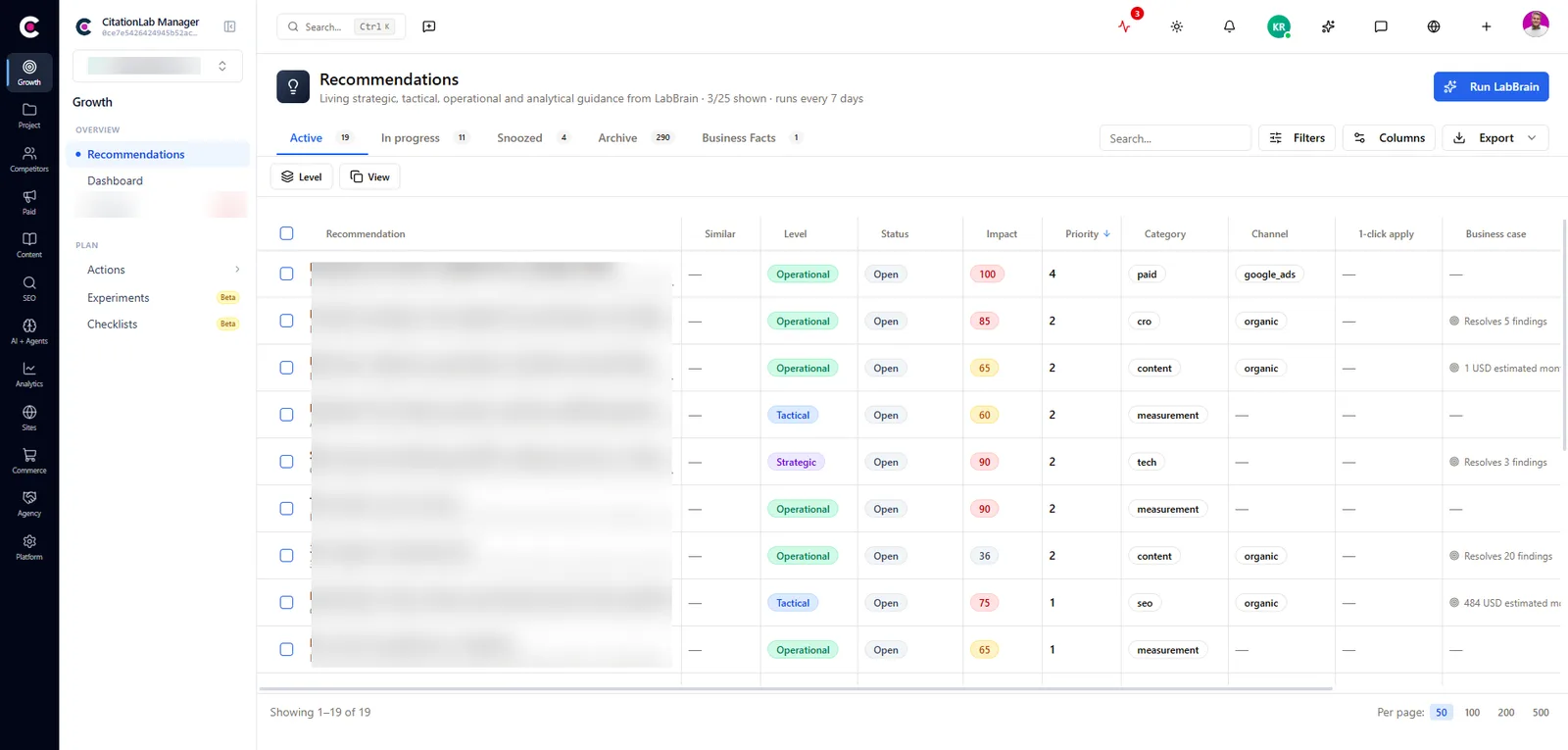
Lab Brain is the module in CitationLab AI Marketing Manager that reads data, findings and strategic goals across modules and turns them into prioritised recommendations at strategic, tactical, operational and analytical level. It forecasts where each KPI is heading and whether a target is at risk. Once a recommendation has been carried out, Lab Brain measures whether the number actually moved, and learns which moves work for your project.
01The problem
Too much data, too few decisions
Search, ads, analytics, content, AI visibility and competitors each have their own dashboard. Each can show that something changed, but none of them tells you what matters most to your business right now.
So the time goes into checking reports instead of acting on them. A drop in clicks is spotted a month too late, an ordinary seasonal dip is treated as a crisis, and the same suggestions turn up in five different tools.
Lab Brain reads it all together and gives you one prioritised list. Each recommendation says what was seen, why it matters and what the next step is, and the result is measured once the work is done.
02How it works
How it works
- 01 / 04
Lab Brain reads your project
Every week, or whenever you ask, Lab Brain goes through your KPIs from the sources you have connected, such as Search Console, GA4, Google Ads and AI Monitor, together with the findings from the modules in Manager.
- 02 / 04
Findings become recommendations
What is really moving is separated from ordinary noise. Findings are weighed against your goals and business profile and become recommendations with a business case and a clear next step.
- 03 / 04
You, or an agent, carry it out
Turn a recommendation into an action in one click and give it an owner, or let an AI agent do the work. If you dismiss a recommendation, you say why, so it doesn't come back.
- 04 / 04
Lab Brain learns
Once the action is done, Lab Brain measures whether the KPI actually moved. The results shape which recommendations it brings forward next time.
03Inside
What you get
Four levels of recommendation
Strategic recommendations change the strategy itself: channels, goals and segments. Tactical ones concern a campaign or initiative, operational ones are a bounded task on a single page. Analytical ones say you need more insight before you act.
One list instead of many
Findings from content, technical SEO, page speed, keywords, ads, competitors, AI visibility and your KPIs are gathered into one prioritised list. Identical recommendations are merged, so you make one decision instead of a hundred.
Forecasts with confidence
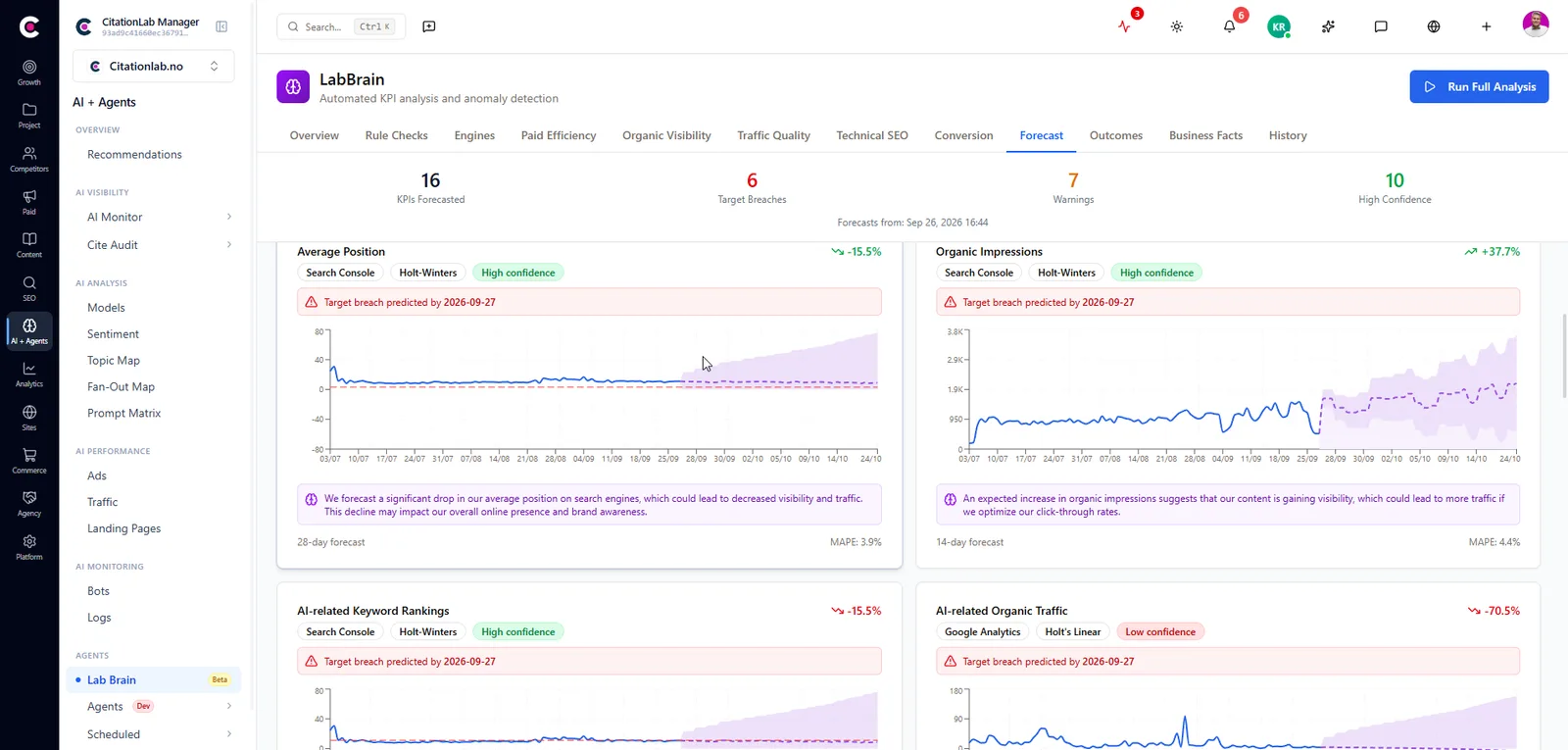
Lab Brain forecasts where each KPI is heading over the coming weeks, with a clear confidence level, and warns you when a target looks set to be missed before it happens.
Ranked by what you want to achieve
Recommendations that move a KPI tied to an important goal rise to the top, especially when that goal is at risk. Many carry an estimated monthly money value in their business case.
A list that stays current
When the problem behind a recommendation goes away, it closes on its own. If the basis changes after you have started on it, the recommendation is flagged so you can check it still applies.
Facts about your business
Lab Brain collects your address, phone number, opening hours and name from your sources and tells you when they disagree. You decide which value is right, directly in the recommendation.
From Manager
04The outcome
What it changes day to day
- You start the week with a prioritised list, not ten dashboards
- Drops and opportunities are caught early, not in the monthly report
- Every recommendation comes with reasoning you can put in front of leadership
- Strategy and day-to-day work connect through the same goals
- Over time you know which kinds of action actually work for your business
05FAQ
Questions about Lab Brain
- What data does Lab Brain need?
- KPIs in your project, pulled from sources such as Search Console, GA4, Google Ads and AI Monitor, or entered manually. The more sources and modules in use, the more Lab Brain has to read across.
- How often does Lab Brain run?
- The analysis runs weekly for every active project, and you can start a full analysis yourself whenever you like. Recommendations are checked against new data in between, so the list doesn't go stale between runs.
- Does Lab Brain make changes on its own?
- No. Lab Brain recommends and you decide. You can accept, snooze or dismiss a recommendation, or turn it into an action for yourself, a colleague or an AI agent.
- What if Lab Brain flags something I know is normal?
- Dismiss the recommendation with a reason and it won't come back. For a seasonal dip you can add an annotation on the date, so whoever reads the numbers later has the context.
- How does Lab Brain learn?
- Completed actions linked to a KPI are measured a few weeks after they were done, taking into account where the number was already heading. What has worked on your project is brought forward next time.
06More modules
It connects to everything else
- ActionsEvery finding, recommendation and change becomes a tracked action with an owner, a priority, a readable key and a measured result.
- Post-analysisAutomatically measures whether a change to a page actually moved clicks, traffic and conversions, after 7, 14 and 28 days.
- AnalyticsCite Analytics, GA4 and Search Console in one place, with traffic from AI assistants, heatmaps, funnels and a measurement plan.
- AI MonitorTracks how ChatGPT, Gemini, Claude, Perplexity, Google's AI answers and Bing respond to the questions your customers ask: who gets cited, who gets mentioned, and how it trends.
Try Lab Brain on your own site
Create an account and set up your first project in a few minutes.
Was this page helpful?