
Module in AI Marketing Manager
Classic SEO, connected to everything else you do
Your keywords, rankings, technical health and competitors sit in the same project as your content, ads and AI visibility. What is wrong becomes recommendations and actions, not yet another report.
SEO and keywords is the module in CitationLab AI Marketing Manager that covers classic search engine optimisation: keyword research, daily rank tracking, technical SEO audits, competitor analysis, content gaps and link monitoring. It uses Google Search Console data and can import keywords from Ahrefs, AccuRanker and Google Ads. Findings become recommendations you can turn into actions, and the changes are measured afterwards.
01The problem
Four tools, four truths, no priorities
Many teams keep keywords in one tool, rankings in another, the technical audit in a third and Search Console in a tab nobody opens. Each tool has its own login and its own picture of reality, and none of them knows what the others found.
The result is long lists with no order. An audit with hundreds of findings says little about what to fix this week, and a keyword that drops doesn't tell you whether a technical fault, a competitor or a change you made yourself is to blame.
SEO and keywords brings the data into the project where your content, campaigns and AI visibility already live. Findings become recommendations with the pages they affect, and a recommendation closes itself once the problem is gone.
02How it works
How it works
- 01 / 04
Connect and add your keywords
Connect Search Console to the project and add the keywords that matter. Import them from Search Console, Ahrefs, AccuRanker or Google Ads, or find new ones from a seed term with volume, difficulty, cost per click and search intent.
- 02 / 04
Rankings are checked every day
Every tracked keyword is checked daily, per country, language and device. You see your own position, your competitors' positions in the same results, and which result types Google showed, including AI Overviews and featured snippets.
- 03 / 04
The site audits itself
The technical audit walks your site the way a search engine does and runs automatically every month, or every week if you prefer. Core Web Vitals for your key pages are followed continuously, and you are alerted when a page starts failing.
- 04 / 04
Findings become recommendations
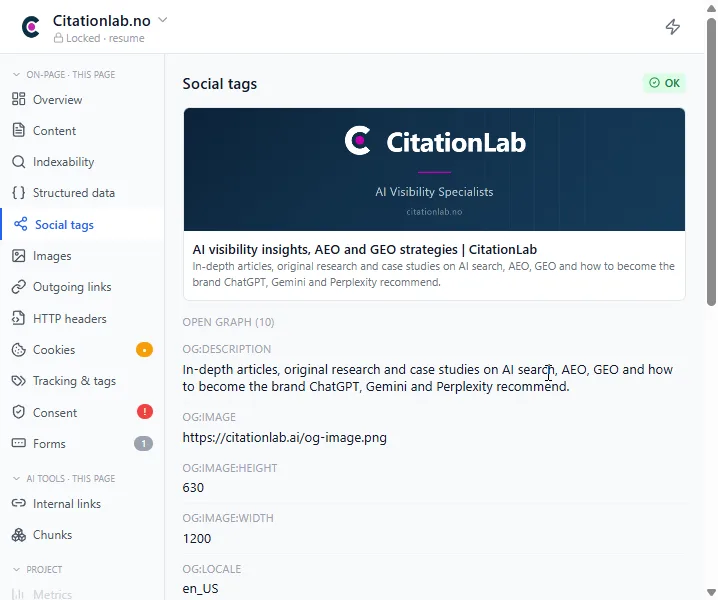
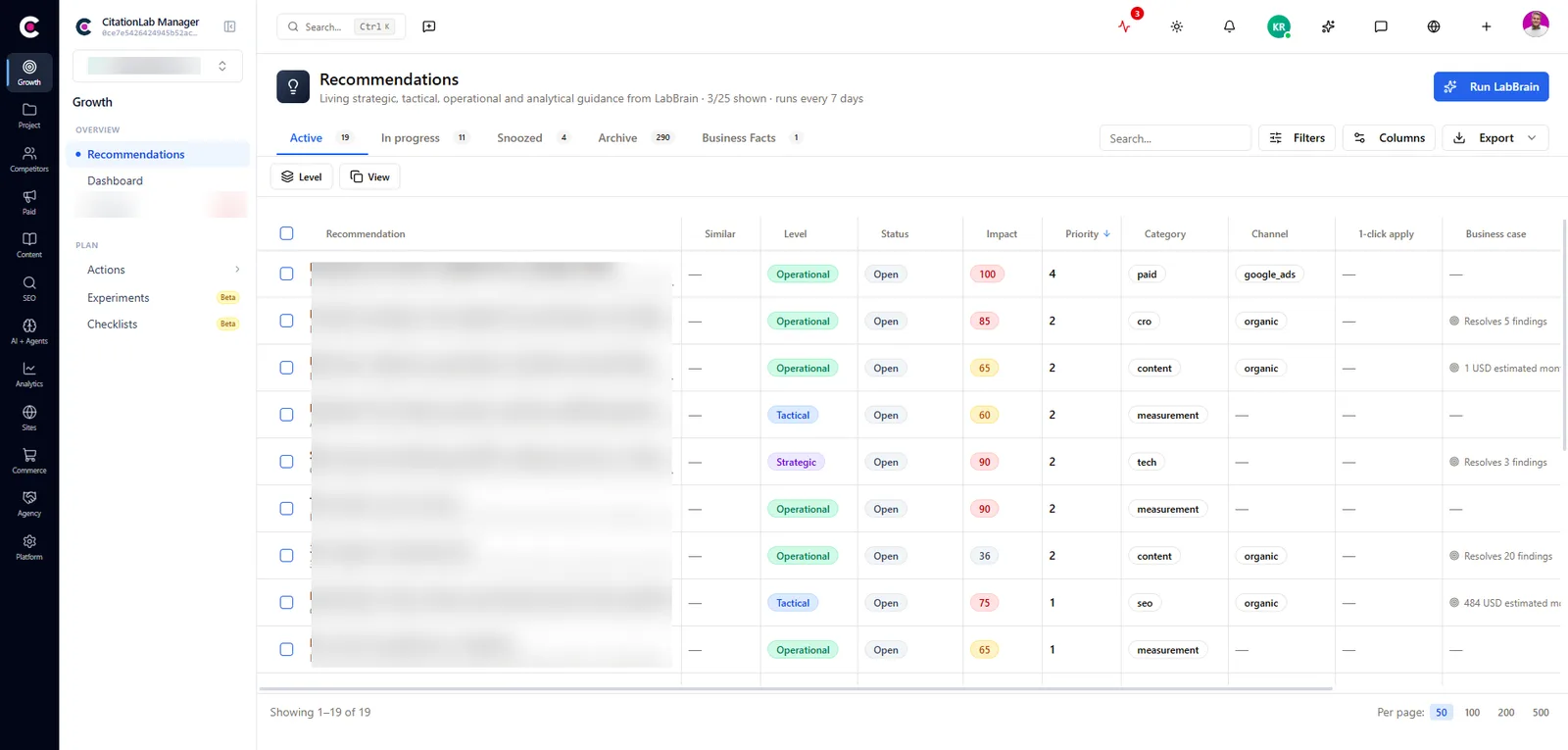
The audit, Cite Audit and your Search Console data are read every night and turned into recommendations with the pages they affect and what to do first. A recommendation becomes an action in one click, and the change is measured afterwards.
03Inside
What you get
Keywords with two volumes
Google search volume, and AI volume: how often the topic is asked of AI assistants like ChatGPT. The explorer shows the trend over time, related terms, the questions people ask and who ranks today. Lists can be shared through a link that needs no account.
Rankings against your competitors
Your position and your competitors', from the same results pages, with visibility and share of top 10 over time. Filter by result types such as AI Overview, featured snippet and "People also ask", and see which ones you own.
Technical SEO that sees AI engines too
Response and redirect errors, indexability, titles and descriptions, thin and duplicate content, structured data, internal linking and performance. And on top, whether AI engines like ChatGPT, Claude and Perplexity can actually reach, read and attribute your content. Findings are sorted by severity, with the number of pages affected.
Your competitors in numbers
Organic traffic, keyword count, paid traffic and estimated ad spend for you and your competitors side by side, the topics they cover and the keywords you share. You get suggestions for competitors you don't follow yet, and a content gap analysis shows what they cover that you don't.
Links you can rely on
Backlink Monitor follows the links you earned or paid for: whether they still exist, point to the right page, carry the agreed anchor text and sit on an indexed page. With Ahrefs connected you see your whole link profile, checked by us for whether the link is really on the page.
Search Console inside the project
Clicks, impressions, click-through rate and position per query and per page, cannibalisation where several of your pages compete for the same query, and brand searches separated from the rest. Pages that rank but get fewer clicks than they should become recommendations of their own.
From Manager
04The outcome
What it changes day to day
- Keywords, rankings, technical health and competitors in one tool instead of four
- You see which competitors are taking your positions, keyword by keyword
- Technical faults are caught by a scheduled audit, not by a customer
- Findings arrive prioritised, with the pages they affect and what to do first
- You know whether your site is reachable for AI engines, not just for Google
05FAQ
Questions about SEO and keywords
- What do I need to get started?
- A project in AI Marketing Manager with your website added. Connect Google Search Console for real search data. Ahrefs and AccuRanker are optional and are read through your own subscription with them.
- Do I get ranking history for keywords I add today?
- No. Rankings are collected from the day a keyword is added, and there is no history to backfill. That is why it pays to add the keywords that matter before you start researching.
- Why are there two volume figures?
- Search volume is how often a keyword is typed into Google each month, and it is the number traffic and priorities are built on. AI volume is how often the topic is asked of AI assistants. It is usually much smaller, but it shows where demand is moving.
- I already use Ahrefs or AccuRanker. Do I have to switch?
- No. Connect them to the project and their data shows up in Manager, and you can import their keywords in a few clicks. Nothing is tracked or bought twice.
- How does this connect to visibility in AI answers?
- The technical audit checks whether AI engines can reach and read your site. Cite Audit assesses whether your pages are worth citing, and AI Monitor follows what ChatGPT, Gemini, Perplexity and Google's AI answers actually say. It all lives in the same project.
06More modules
It connects to everything else
- Content and publishingPlan, write, quality-check and publish content to your own CMS, with every URL and every change in one place.
- Cite AuditGoes through the content on your site and shows why AI engines cite you or pass you over, page by page, with concrete fixes.
- AI MonitorTracks how ChatGPT, Gemini, Claude, Perplexity, Google's AI answers and Bing respond to the questions your customers ask: who gets cited, who gets mentioned, and how it trends.
- Post-analysisAutomatically measures whether a change to a page actually moved clicks, traffic and conversions, after 7, 14 and 28 days.
Try SEO and keywords on your own site
Create an account and set up your first project in a few minutes.
Was this page helpful?