
Module in AI Marketing Manager
Find out why AI cites you, or doesn't
Cite Audit reads your pages the way an AI engine weighs them as a source. You get a score per page and per area, the most serious findings first, and a concrete recommendation for each one.
Cite Audit is the module in CitationLab AI Marketing Manager that assesses a website's content for how well AI assistants and answer engines can understand, trust and cite it. It goes through your pages, gives each page a score and lists the findings by severity, with a concrete recommendation for every finding. Findings become actions in one click, and the audit can run by itself every month.
01The problem
A page can rank in Google and still never get cited
AI engines pick a handful of sources for each answer. A page that does well in regular search can still be passed over because the answer is buried far down, the claims stand without support, or the page says something different from the rest of the site.
Regular SEO tools look for technical errors: status codes, redirects, missing titles. They say little about whether the content actually answers the question, whether it stands apart from competitors, or whether an AI engine can lift an answer out of it.
Cite Audit looks at exactly that. Instead of a generic checklist, you get an answer per page on what keeps you out of AI answers, and what to change first.
02How it works
How it works
- 01 / 04
An audit starts
Start it yourself from Cite Audit, let an AI agent start it over MCP, or let it run by itself every month. The first one often runs during project setup.
- 02 / 04
The pages that matter most, first
When the site has more pages than the audit covers, it starts with the pages people actually visit, based on Google Analytics and Search Console, and fills the rest from the sitemap, so new pages are included too.
- 03 / 04
Every page gets a score and findings
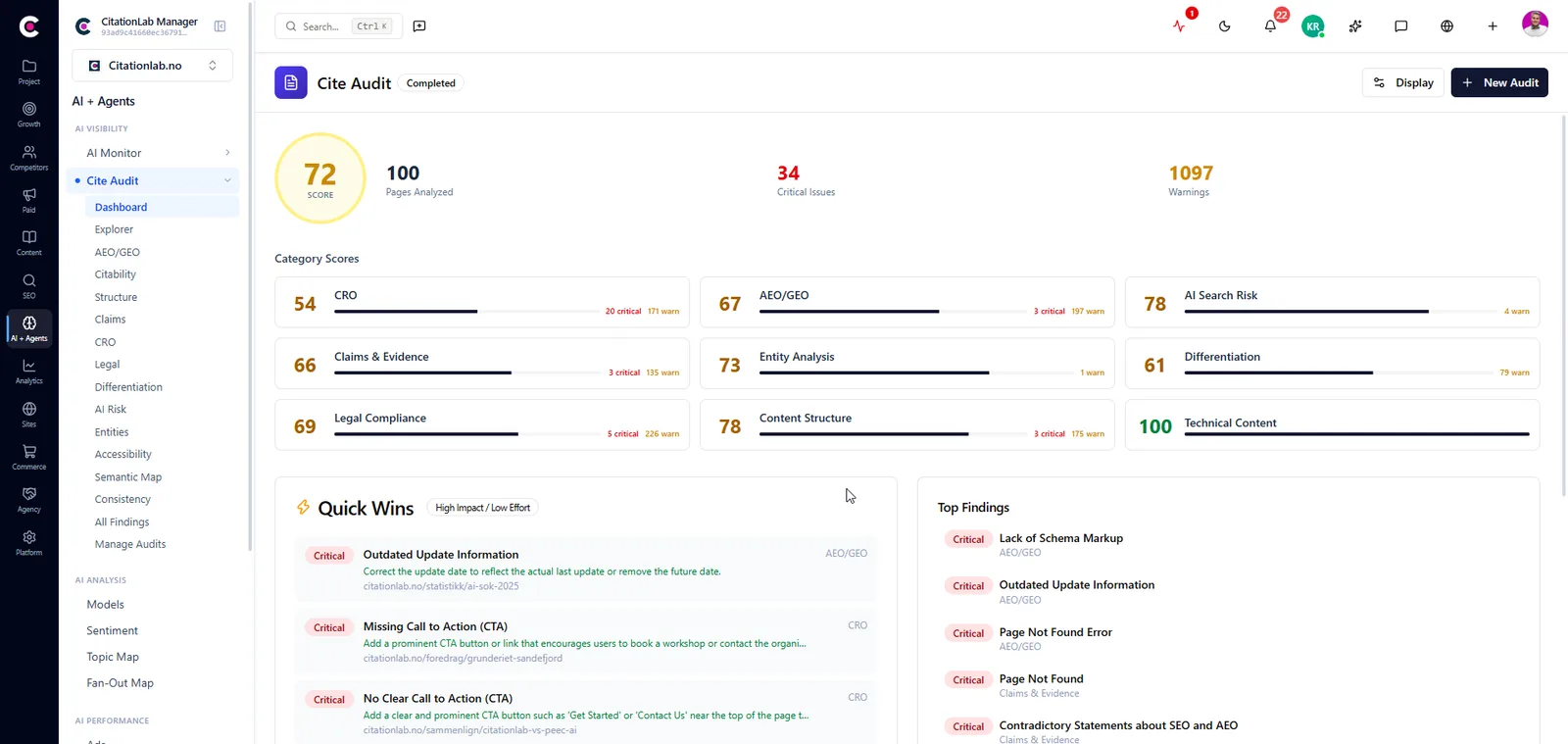
You get an overall score, a score per area and the findings ranked by severity. Each finding points to the page it concerns and says what should change.
- 04 / 04
Findings become actions
Turn a finding into an action in one click and hand it to a colleague or an AI agent. Once the page is changed, post-analysis measures whether it moved your traffic.
03Inside
What you get
A score per page and per area
An overall score for the site, a score for every page, and dedicated views for areas such as AEO/GEO, citability, structure, and claims and evidence. Critical issues and warnings are kept apart, so you see what's urgent.
Quick wins first
Findings with high impact and low effort are pulled to the top of the dashboard, with the recommendation and the page they concern, so the first hours go where they count.
The entities your pages establish
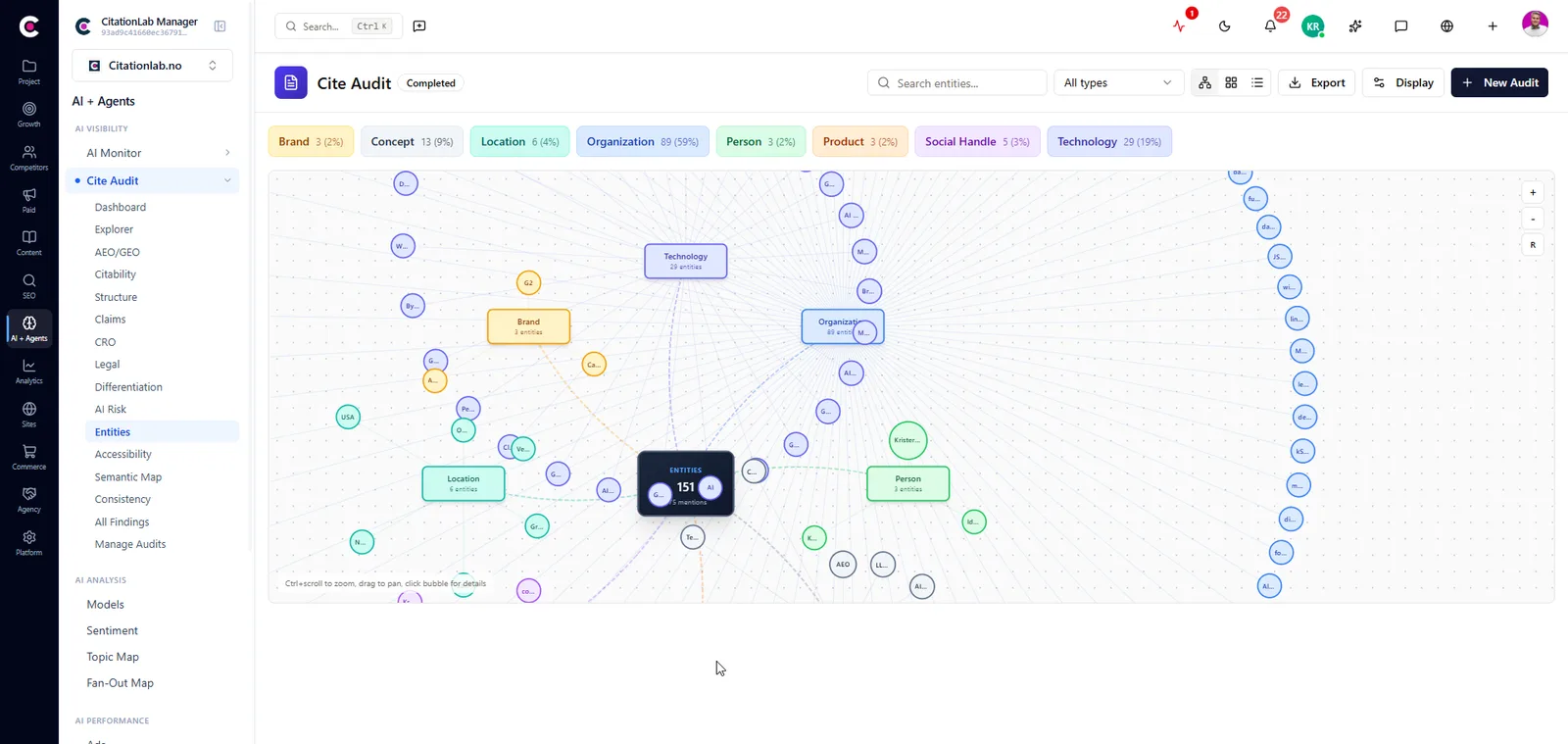
Brands, people, organisations, products, places and concepts your content ties itself to, shown as a map by type. You see what your site actually tells an AI engine about who you are.
One site, one truth
Names, prices and facts that contradict each other between pages, two pages answering the same question, and pages that conflict with the facts you've recorded in the project's memory.
More than AEO
The same pass also looks at conversion, legal issues, how much the content stands apart from competitors, AI-sounding filler, and accessibility, including for AI agents that need to use the page.
Take the whole audit with you
Export a single view, or the whole audit as Excel, CSV or JSON, with every page, score and finding. The findings are also read by Lab Brain and by the SEO recommendations in Manager.
From Manager
04The outcome
What it changes day to day
- You know why a page isn't cited, instead of guessing
- Content work is ranked by severity and impact, not by whichever page came up first
- Conflicting facts on your site are found before an AI engine repeats the wrong version
- Every finding can be followed from recommendation to action to measured result
- The monthly audit shows whether the site is actually getting better over time
05FAQ
Questions about Cite Audit
- How is Cite Audit different from AI Monitor?
- AI Monitor shows what the AI engines answer and whom they cite. Cite Audit looks at your own pages and explains why they are cited or not. Together they give you the result and what to do about it.
- Is this the same as a technical SEO audit?
- No. The technical audit in Manager looks for technical errors on the site. Cite Audit reads the content and assesses whether it answers clearly, is credible and can be cited. They complement each other, and both feed the same recommendations.
- Which pages are assessed?
- Your plan includes a number of pages per month, shared by the whole organisation. The audit starts with the pages that get the most traffic and fills the rest from the sitemap, so a new page without visits yet is included too.
- Does it run automatically?
- Yes. Cite Audit can run by itself once a month, overnight, on your most-visited pages. You choose monthly or off, and see how much of the month's pages has been used.
- What do I do with the findings?
- Every finding has a recommendation and can be turned into an action in one click. Start with the most serious findings and the quick wins. When the change is made through Manager, its effect is measured automatically.
06More modules
It connects to everything else
- AI MonitorTracks how ChatGPT, Gemini, Claude, Perplexity, Google's AI answers and Bing respond to the questions your customers ask: who gets cited, who gets mentioned, and how it trends.
- ActionsEvery finding, recommendation and change becomes a tracked action with an owner, a priority, a readable key and a measured result.
- Lab BrainReads across modules, forecasts where your KPIs are heading and gives prioritised recommendations that learn from what actually worked.
- Post-analysisAutomatically measures whether a change to a page actually moved clicks, traffic and conversions, after 7, 14 and 28 days.
Try Cite Audit on your own site
Create an account and set up your first project in a few minutes.
Was this page helpful?